

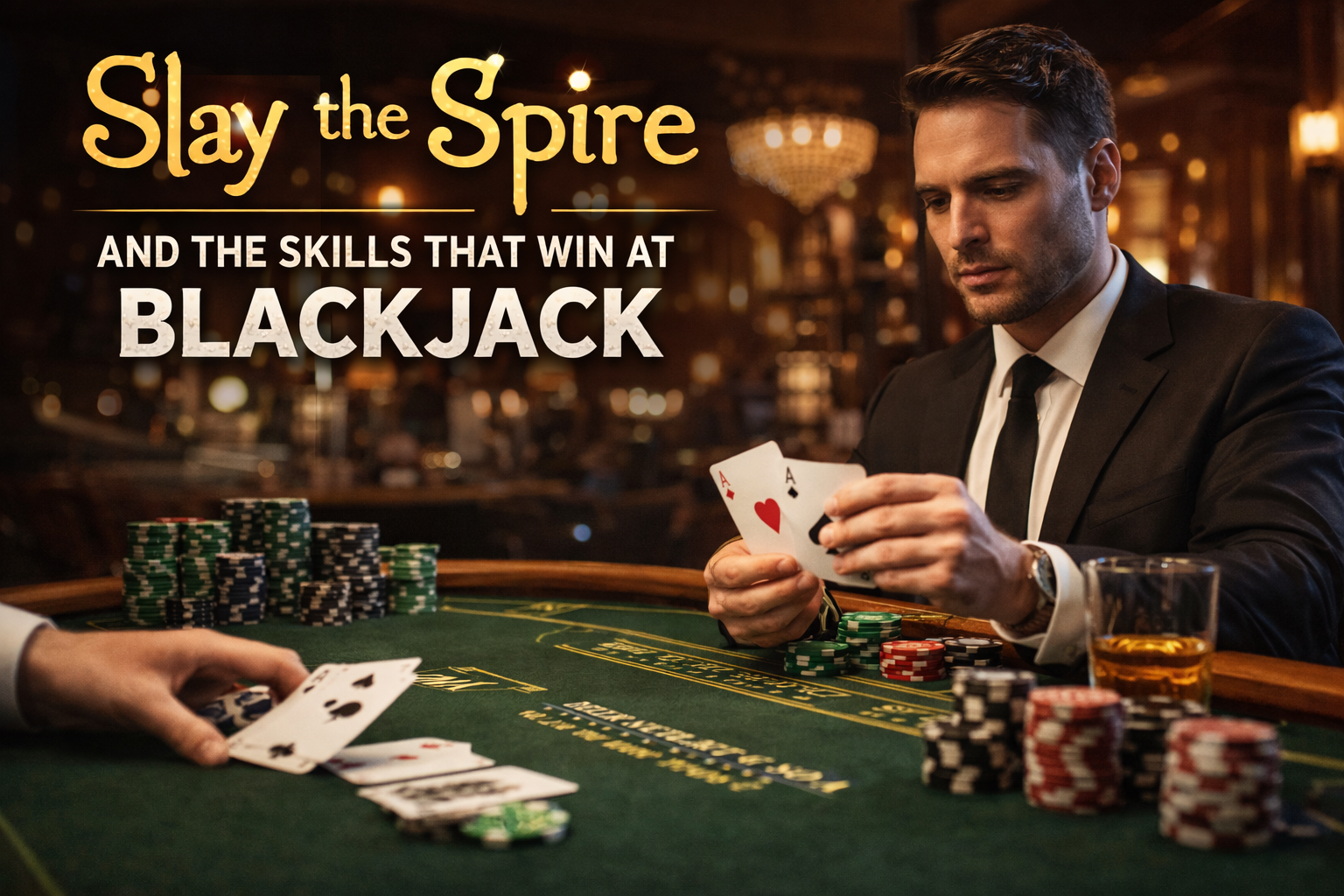
You’re on the final floor. Your deck is a finely tuned machine, your relics hum with power, and the Corrupt Heart awaits.
Every card draw, every potion used, every calculated risk has led to this moment. If you’ve ever felt the intellectual thrill of a perfect run in Slay the Spire, Balatro, or Monster Train, you’ve already been training a skill set that is surprisingly relevant in the world of classic card games.
The mental muscles you flex to conquer the Spire are the same ones that give skilled players an edge at the blackjack table.
It’s all about managing probability, assessing risk, and making the best decision with the information you have. Here is how your roguelike deckbuilder habits translate.
The Art of the Calculated Risk, Deck vs Shoe
One of the first things a new Slay the Spire player learns is the importance of a lean deck. You actively remove the starting “Strike” and “Defend” cards to increase the odds of drawing your powerful combo pieces.
Every card removed makes your deck more predictable, more potent. You are, in essence, manipulating the probability of future draws in your favor.
This concept has a fascinating parallel in blackjack: card counting. While it sounds complex, the core idea is straightforward.
Players track the ratio of high-value cards (10s and Aces) to low-value cards remaining in the dealer’s shoe. When the shoe is rich in high cards, the player holds a statistical advantage and can increase their bets accordingly.
Just like removing a “Strike” makes drawing “Catalyst” more likely, a stream of low cards leaving the shoe makes drawing a natural blackjack more likely. In both cases, you are not guessing. You are using memory and observation to understand the shifting composition of the remaining cards.
That process only becomes meaningful once you understand blackjack house rules, since it is the rule framework that determines how the dealer acts, when payouts apply, and where the real edges in the game actually live.
Expected Value and Choosing the Right Move
Every decision in a deckbuilder is a small wager on expected value (EV). Do you play a card that deals 8 damage for certain, or one that has a 50% chance to deal 20?
The answer depends on your health, the enemy’s intent, and what you know remains in your draw pile. You are constantly evaluating which play will, on average, produce the best outcome over time.
This is the absolute heart of blackjack strategy. When the dealer shows a 6 and you hold a total of 15, the decision to hit or stand is not about what will happen on this one hand. It is about which action carries the highest positive EV across thousands of hands.
Strictly following a mathematically grounded basic strategy can reduce the house edge to less than 1%. You are not trying to win every hand.
You are trying to make the most sound decision every single time, trusting that the odds will work in your favor over the long run.
Adapting Your Strategy on the Fly
No two runs in a roguelike are the same. You might aim for a poison build with the Silent, but if the game keeps offering Shiv cards and the Shuriken relic, you adapt.
The strongest players are not those who force a single strategy onto every run, but those who build the most powerful deck possible from the random opportunities presented to them.
This flexibility is just as crucial at the card table. A basic blackjack strategy chart provides a powerful baseline for play, but skilled players adjust based on how the game evolves.
That adjustment is only possible when you have a clear picture of the numbers behind each decision, which is why understanding blackjack odds matters so much for players who want to move beyond rote memorization.
In blackjack, this might mean shifting your bet size or deviating from basic strategy when the card count moves to an extreme.
Just as you would never ignore a game-changing relic in Slay the Spire, a skilled blackjack player does not ignore the valuable information a changing shoe provides.
FAQs
Is card counting similar to tracking your deck?
In principle, yes. Both techniques involve tracking which cards have left a limited pool to make better predictions about what comes next. The goal is identical: shift the odds in your favor through informed decision-making rather than guesswork.
Do deckbuilders sharpen real card game strategy?
Playing deckbuilders will not teach you specific rules, but it sharpens the core mental skills: probability assessment, risk management, and long-term strategic thinking. Training your brain to reason in terms of odds and outcomes is directly transferable to any strategy-based card game.
How does roguelike risk differ from blackjack risk?
In roguelikes, the consequence of risk is a lost run and a fresh start. In blackjack, risk carries real-world financial stakes. The strategic principles overlap significantly, but the emotional pressure and practical consequences are entirely different.
Are there other games that build similar probability skills?
Yes. Games like XCOM, where decisions hinge on percentage chances to hit, are strong examples. Digital card games such as Hearthstone and Legends of Runeterra also reward an understanding of odds, resource management, and reading an opponent’s likely plays from limited information.
