

wp:paragraph
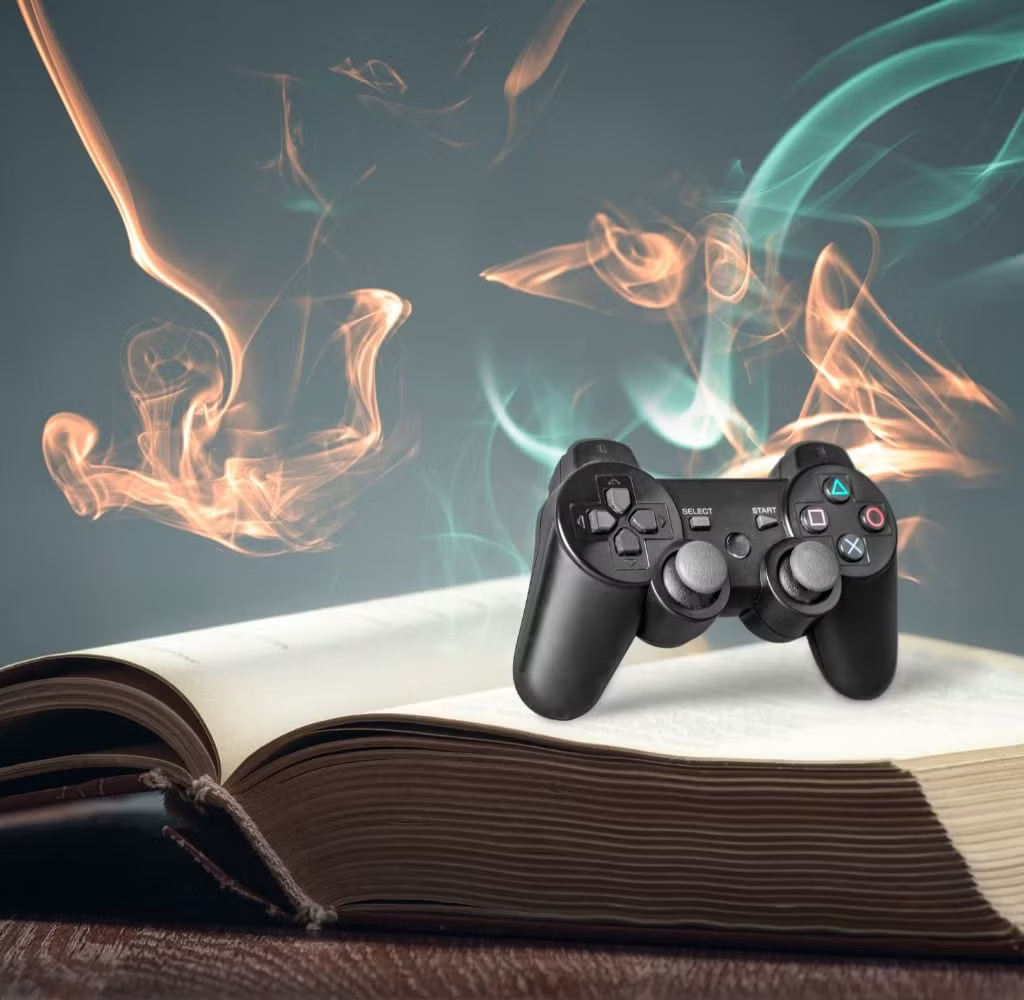
It starts with a sentence. A sword unsheathed. A castle cloaked in fog. A stranger steps into a tavern, their past heavy as the rain on their cloak. That’s the novel. Now imagine: instead of turning the page, you pick up a controller. Welcome to the realm where books bleed into pixels and fantasy spills beyond the printed word.
/wp:paragraph
wp:paragraph
The line between literature and interactive media has been thinning for decades. Video games inspired by books are no niche — they’re a growing ecosystem. And the novels’ impact on video games? That’s not just creative; it’s architectural. World-building. Character crafting. Dialogue writing. Even game mechanics owe a silent nod to the bound paper ancestors.
/wp:paragraph
wp:heading {“level”:3}
Press X to Read: The Literary Blueprint
/wp:heading
wp:image {“id”:25471,”width”:”532px”,”height”:”auto”,”sizeSlug”:”large”,”linkDestination”:”none”,”align”:”center”}
/wp:image
wp:paragraph
A game doesn’t just appear, and it rarely begins with a joystick. Often, it starts with lore — deep, layered, breathing backstory. And books? They’re masters of lore.
/wp:paragraph
wp:paragraph
Take The Witcher series. Before Geralt of Rivia slashed his way across PC and console screens, he brooded on the pages of Polish author Andrzej Sapkowski’s novels. CD Projekt Red didn’t just adapt The Witcher — they extended it, gamified it, and made it tactile. The result? Over 50 million units sold by 2023. That’s not just commercial success; that’s cultural fusion.
/wp:paragraph
wp:paragraph
Then there’s Metro 2033, born from the dark, dystopian vision of Dmitry Glukhovsky. The tunnels of post-apocalyptic Moscow weren’t dreamed up by a level designer; they were first inked in sentences. The mood, the tension, the very claustrophobia of the game — lifted straight from the novel’s spine.
/wp:paragraph
wp:paragraph
Even Middle-earth: Shadow of Mordor, though not a direct adaptation, wouldn’t exist without J.R.R. Tolkien. His meticulous crafting of languages, geography, lineage, and moral complexity laid the foundation for nearly every fantasy RPG since. Elves didn’t start in Skyrim, after all.
/wp:paragraph
wp:paragraph
What conclusion can be drawn? If you want to understand the characters and their motives more deeply, start reading stories. You don’t have to buy books, you can choose a reading app like FictionMe. Moreover, you can always find a selection of alpha stories free or books about romantic triangles among office workers. Almost anything is available right on your smartphone.
/wp:paragraph
wp:heading {“level”:3}
Fictional DNA: Embedding Novels into Code
/wp:heading
wp:paragraph
Here’s the twist — books don’t just provide stories. They shape design. They mold mechanics. They whisper to AI.
/wp:paragraph
wp:paragraph
NPCs, or non-playable characters, are often overlooked. Yet they carry a game’s soul. In titles influenced by literature, these characters aren’t filler — they’re extensions of the original text. They speak in the rhythms of the novel’s voice. Their decisions reflect narrative logic, not just code.
/wp:paragraph
wp:paragraph
In Disco Elysium, for instance, the game operates more like a psychological novel than a standard RPG. Dialogue trees are dense. Introspection is constant. The player is both detective and unreliable narrator. Influenced by the writings of Dashiell Hammett and literary existentialism, it blurs the lines: where does reading stop and playing begin?
/wp:paragraph
wp:paragraph
Statistically speaking? A 2022 survey by the ESA found that 47% of players said a game’s story was the top reason they played. And if the story matters, then its source — its novelistic DNA — matters even more. Does it make sense to visit the world of the original source? Most likely a rhetorical question.
/wp:paragraph
wp:heading {“level”:3}
Genre Bending: Where Literature Makes Games Weird
/wp:heading
wp:paragraph
Not every adaptation is literal. Sometimes, novels simply nudge games into new territory. They offer strange angles. Risky rhythms. Structureless structures. And suddenly, the game isn’t playing fair — it’s playing with format.
/wp:paragraph
wp:paragraph
Sunless Sea and Fallen London are prime examples. Based on the slow-burn literary style of Victorian gothic and Lovecraftian horror, these games meander. Dialogue is long. Decisions are agonizing. Death is not defeat; it’s lore generation. You don’t just win. You read your way through the abyss.
/wp:paragraph
wp:paragraph
And then there’s 198X, a game that feels like an autobiographical novella dipped in synthwave. While it’s not adapted from a book, its structure — segmented, moody, internal — mirrors a coming-of-age story more than a typical side-scroller.
/wp:paragraph
wp:heading {“level”:3}
The Feedback Loop: When Games Write Back
/wp:heading
wp:image {“id”:25472,”width”:”566px”,”height”:”auto”,”sizeSlug”:”large”,”linkDestination”:”none”,”align”:”center”}
/wp:image
wp:paragraph
Here’s something curious. Once, books inspired games. Now, games are inspiring novels.
/wp:paragraph
wp:paragraph
There are now shelves of game-based literature — from Assassin’s Creed to Mass Effect — spinning new tales from interactive worlds. Writers who once imagined prose are now world-builders for game studios. This isn’t theft. It’s a dialogue. A loop. A literary feedback system.
/wp:paragraph
wp:paragraph
What starts in ink becomes code. What becomes code loops back to ink.
/wp:paragraph
wp:heading {“level”:3}
Turning Pages, Pressing Buttons
/wp:heading
wp:paragraph
Let’s get something straight: storytelling isn’t loyal to one format. It’s migratory. It travels, adapts, mutates. Novels impact video games not by simply being adapted — but by infecting the creative bloodstream. Syntax becomes sound design. Paragraphs become quests. Metaphor becomes level architecture.
/wp:paragraph
wp:paragraph
Are we saying every game needs a literary origin? Not quite. Some are pure play. But the ones that stick — the games that tattoo themselves onto memory — often have narrative roots deep in novelistic soil.
/wp:paragraph
wp:paragraph
To play them is to read differently. With your thumbs.
/wp:paragraph
wp:paragraph
So next time you slay a dragon or debate a morally gray NPC, consider this: someone, somewhere, once wrote that moment down. Not in code, but in chapters.
/wp:paragraph
wp:paragraph
And somehow, through screens and speakers, you’re still turning the page.
/wp:paragraph
