

You request a withdrawal, and instead of a payout confirmation, you get a message saying your account is under review. It feels personal — like the casino waited until you won to slam the door. In most cases, though, the timing isn’t random at all.
Cashing out is simply the first moment an operator is forced to look closely at who you are. Here’s what’s really going on, and how to get your money moving again.
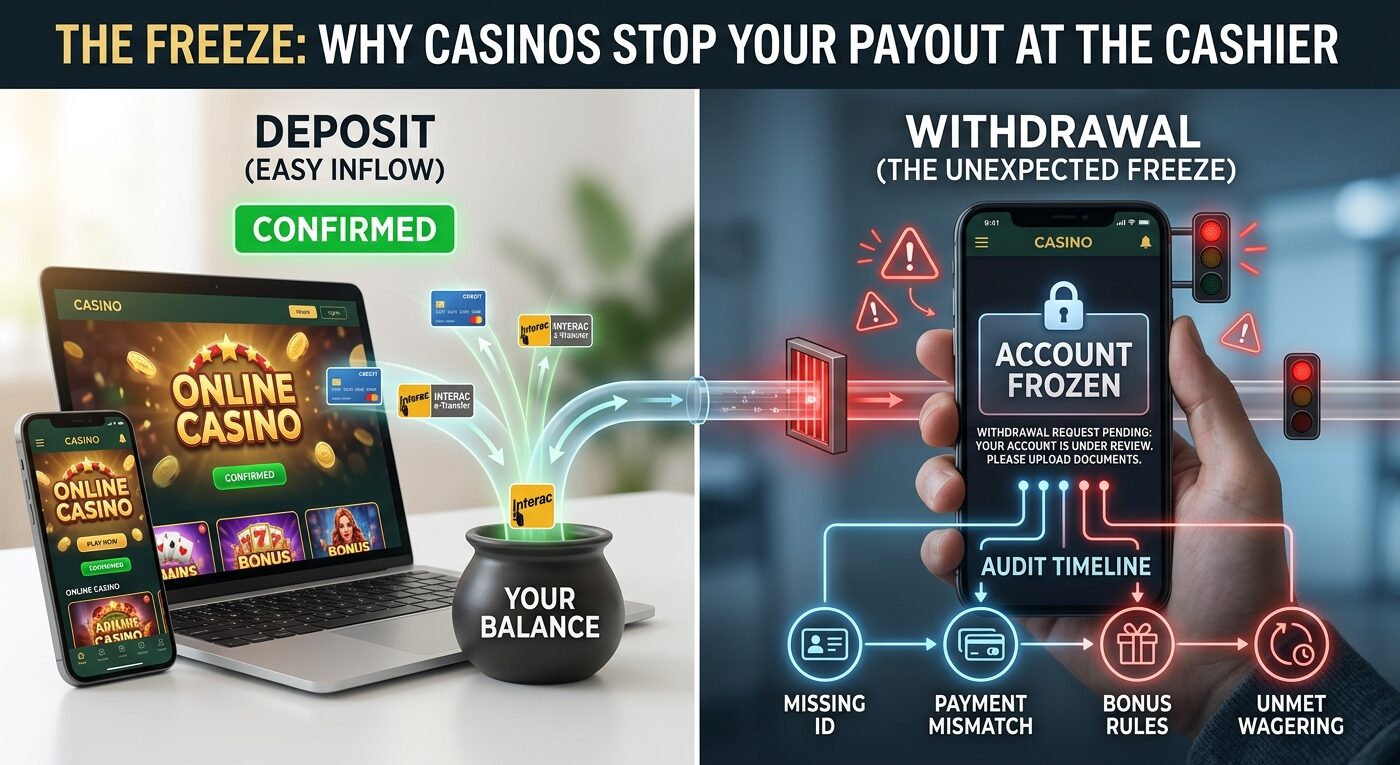
Deposits are frictionless — withdrawals trip the alarms
Casinos make depositing easy on purpose: a card, an Interac transfer, a few taps and you’re playing. Money flowing out is a different story.
The moment you request a payout, the operator has to confirm it’s sending winnings to a real person — not a stolen card, a bonus abuser, or a laundering scheme.
Regulators in Canada, from iGaming Ontario to the Kahnawake Gaming Commission, require these checks, and offshore licensing bodies impose similar rules.
So the freeze usually isn’t the casino picking on you. It’s the first time your account has ever been audited, and anything unfinished in your profile suddenly matters.
The triggers behind almost every frozen payout
Look through player complaints and casino terms, and the same handful of triggers shows up again and again. Knowing them lets you spot your own risk before you ever hit withdraw:
- Unfinished identity checks — you never uploaded ID, or your documents expired before the review.
- Unmet wagering requirements — the bonus says 35x, and the cashier can see you haven’t cleared it.
- Payment method mismatches — depositing with Visa, then withdrawing to an e-wallet in a different name.
- Duplicate accounts — two sign-ups from the same household, device, or IP address.
- Bonus-style betting patterns — max bets with active bonus funds or hopping between promotions.
Any one of these can park a withdrawal in review for days. The frustrating part? Most players trip them accidentally, long before cashing out, and only find out at the worst possible moment.
Verification is the check everyone postpones
Know-your-customer verification — a government ID, a recent utility bill, sometimes a photo of your card — takes ten minutes when your balance is small.
At withdrawal, with hundreds of dollars on the line, it can stretch into a week of back-and-forth emails. Casinos know players skip it, which is why so many freezes trace back to a folder of missing paperwork.
Choosing where you play matters just as much. Canadian players comparing welcome bonuses, slot libraries, and live dealer tables often browse the games at https://mr.bet/ before making a first deposit, and that kind of homework pays off: an operator with hundreds of online slots, blackjack and roulette tables, and clearly posted wagering rules has no reason to stall a legitimate cashout. Check the cashier page, skim the payout terms, and save yourself the standoff.
How to make your account freeze-proof?
A little setup work in your first week eliminates nearly every trigger above. Work through these steps before you build a balance worth fighting over:
- Verify immediately. Upload your ID and proof of address right after sign-up, when nothing is at stake.
- Read the bonus terms before opting in — know the wagering multiplier, the max bet, and which games count.
- Use one payment method, in your own name, for both deposits and withdrawals.
- Keep it to one account — no second sign-ups, even for a fresh welcome offer.
- Withdraw winnings in reasonable chunks rather than letting a huge balance pile up.
None of this guarantees instant payouts, but it removes every easy excuse a casino has for holding your money.
If the freeze has already happened
Start with your inbox — the review email usually lists exactly what’s missing. Reply to support promptly, send clean copies of whatever they request, and keep every message in writing. Ask for a timeline; legitimate operators will name the reason and give you one.
If days turn into weeks and the requests keep changing — a third utility bill, a notarized selfie, silence — escalate.
Licensed Canadian-facing sites answer to a regulator, and a formal complaint through iGaming Ontario, the Kahnawake commission, or the casino’s licensing body gets attention fast.
When a freeze is actually a red flag
Some freezes aren’t compliance — they’re stalling. Warning signs: support demands a deposit to “unlock” your withdrawal, invents new document requests after you’ve complied, or simply stops answering. No legitimate casino asks for money to release your winnings.
If you see that pattern, stop depositing, document everything, and take the complaint to the regulator and public review sites. The casinos worth your bankroll treat a withdrawal like a promise, not a negotiation.
