

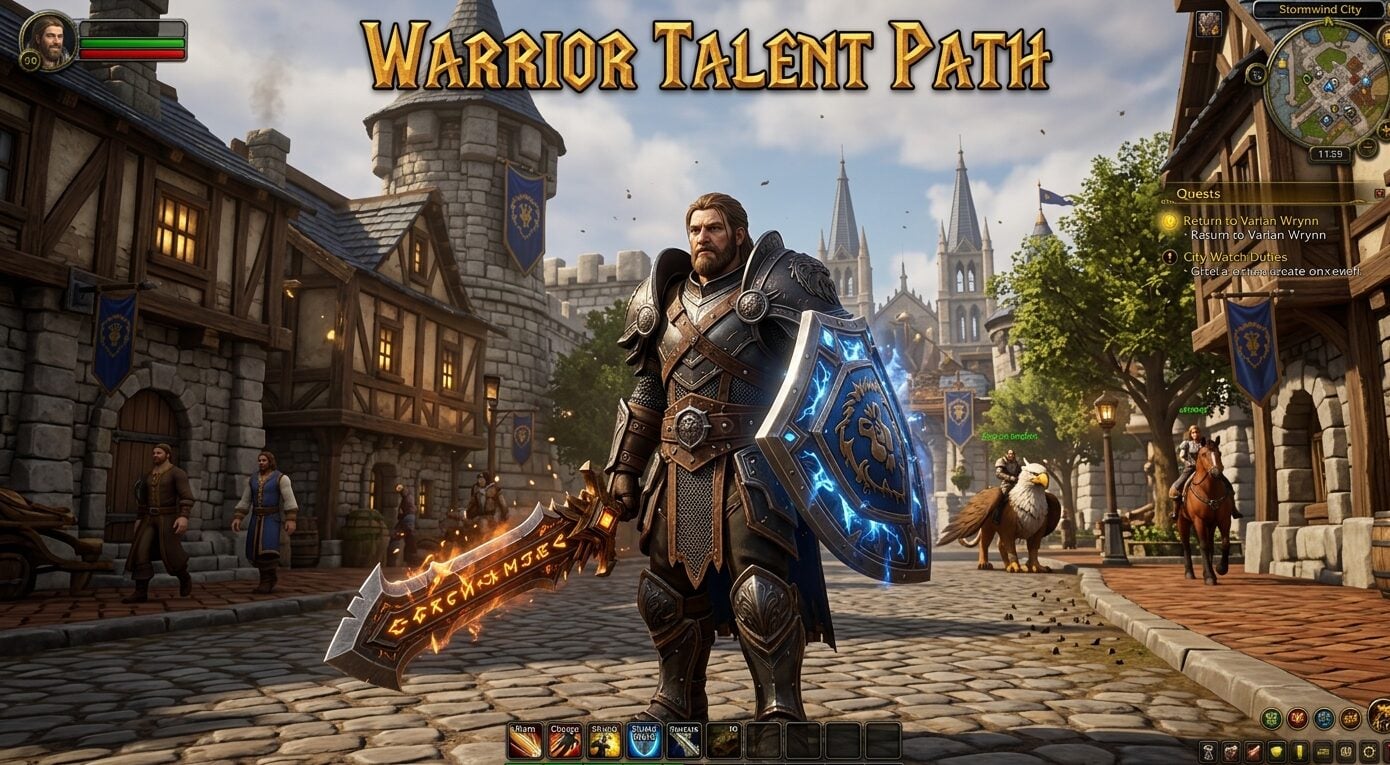
You are standing in Orgrimmar or Stormwind with your very first talent point, and the tooltip says nothing about the next fifty.
Warriors in Classic Era are famously forgiving at low levels and famously demanding at the top. A plan made now saves gold later, because respecs get pricier each time you use them.
Follow these steps in order.
Decide your endgame role before you spend anything
Warriors can tank, deal melee damage or do a bit of both. Classic raiding wants all three flavors, but one character rarely does everything well.
Ask your guild what it lacks. If it needs a main tank, you are looking at Protection. If it needs sustained damage, you are looking at Fury or Arms. Your answer shapes the first thirty points you spend.
Draft the whole build on paper
Do not wait until level 40 to think about it. Open a classic talent calculator, plug in the full fifty-one points you will have at the cap, and save the link.
Now you can see which talents are mandatory, which are comfortable and which are luxuries. Move the plan forward in small pieces, one level at a time, instead of improvising.
Level 10 to 20, take what speeds up questing
Early points should reduce downtime and increase your ability to survive pulls. Anything that boosts your rage generation or improves your basic attacks pays off immediately. Resist the urge to chase a flashy capstone you will not reach for another forty levels.
Level 20 to 40, pick your leveling lane
Many players choose Arms for its strong two-handed weapon synergy while leveling, then switch later. Others go Fury early because their damage feels smoother in dungeons.
Whichever you choose, keep an eye on the talent that makes your weapon swings hit harder, and make sure you pick up the abilities that make fights shorter. Shorter fights mean less eating and drinking time.
Level 40 to 51, lock in the deep talents
Around this range, the third-tier talents begin to feel meaningful. Arms players look toward the bleed and the signature strike.
Fury players aim for their burst cooldown and the instant attack that defines the tree. Protection players aim for the high-threat shield strike and the survival cooldown that rescues a bad pull. Spend carefully, because every point you place in the wrong tree has to be paid for again if you respec.
Dungeon tanking while leveling
If you want to tank dungeons on the way up, a Protection-leaning hybrid is possible. Pick talents that raise threat and improve your defensive stats.
Keep a one-handed weapon and shield in your bag. Group leaders will quickly notice a warrior who can hold aggro, and you will skip long queue times in return.
Know your rage economy
Warriors do not use mana. They build rage by hitting enemies and by taking damage, then spend it on abilities.
That means your talent plan should respect the resource loop. A build that lets you spend rage faster than you gain it will leave you standing still with a sword and no tricks.
Watch your rage bar during a few trash pulls and note which abilities you cannot afford to use. If the same one keeps going unused, your talents are probably pulling in the wrong direction.
Pre-raid adjustments
Before you step into Molten Core, review the fights you expect. Fire resistance and boss mechanics matter more than a theoretical damage gain.
Talk to your raid leader about your role and ask whether the group already has enough tanks. A good warrior adapts to the roster and does not insist on a favorite build.
Budget for respecs
Respec costs rise as you repeat them, then reset after a while. Treat each respec as a purchase. If you plan to swap between a leveling build and a raid build, set aside gold in advance. It is better to know the price than to be surprised at the trainer.
Common mistakes
- Spreading points across three trees without a goal.
- Ignoring weapon type. Talents that reward two-handed weapons do little if you carry a dagger.
- Copying a raid build at level 30 and finding it too slow for questing.
- Forgetting that threat matters. Even a damage-focused Warrior needs to avoid pulling aggro from the tank.
A last check before you commit
Read your plan out loud. Can you explain why each point is there in one sentence? If yes, spend it. If no, move it.
A build you understand will carry you through Molten Core and beyond, and the moment you feel stuck, you can return to the draft, adjust one branch and keep climbing.
